

The Ellis Method: Passive, Water-Free Cooling for Data Centers
- Abstract
- 1. Introduction
- 2. Problem Context
- 3. System Overview
- 4. Physical Principles
- 5. Operational Modes
- 6. Implementation Considerations
- 7. Environmental and Economic Benefits
- 8. Public Domain Dedication (CC0)
- 9. Author’s Philosophical Statement
- 10. Stewardship & Voluntary Support (Optional)
- 11. Conclusion
- Appendix A: Ellis Passive Cooling Stewardship License (EPCSL)
Abstract
Global water consumption by data centers—especially those supporting AI workloads—is rising sharply. Traditional evaporative cooling systems impose significant freshwater burdens on regions already experiencing climate stress. This paper presents an open, public-domain architectural concept combining solar chimneys, subterranean cool-air galleries, and closed liquid-loop heat exchangers to create a water-free, passive cooling assist system capable of reducing mechanical cooling requirements for high-density servers. Leveraging natural buoyancy forces and deep-soil thermal stability, the approach offers meaningful reductions in cooling energy, peak load, and water demand. This work is released under the Creative Commons CC0 Public Domain Dedication and is accompanied by a voluntary stewardship framework intended to support responsible dissemination.
1. Introduction
Artificial intelligence infrastructure is expanding rapidly. High-density GPUs, specialized accelerators, and large-scale model training create unprecedented thermal loads within modern data centers. Conventional cooling solutions rely heavily on evaporative cooling towers and adiabatic processes, which consume large quantities of potable water—often in regions already facing water scarcity.
At the same time, many data centers are being constructed in climates characterized by high solar availability, low humidity, and large diurnal temperature swings. These conditions are well-suited to passive cooling strategies that leverage environmental gradients rather than water-intensive mechanical systems.
This paper introduces a scalable concept for water-free, low-energy thermal management. The approach is not intended to replace conventional cooling entirely, but to significantly reduce peak demand, water consumption, and mechanical runtime.
2. Problem Context
2.1 Rising Water Demand in AI Cooling
Large data centers may consume millions of liters of freshwater per day during peak cooling periods. This consumption is driven primarily by evaporative cooling towers and adiabatic stages used to reject heat generated by high-density compute workloads.
2.2 Energy and Carbon Implications
Mechanical cooling increases electrical demand and, where grid power is fossil-fuel based, indirectly increases carbon emissions. Reducing cooling load through passive means improves both water efficiency and overall energy performance.
2.3 Opportunity in Natural Temperature Gradients
Subsurface soil temperatures several meters below grade remain relatively stable throughout the year and are often significantly cooler than daytime ambient air. Solar chimneys, by contrast, exploit solar radiation to heat air within a vertical shaft, creating buoyant upward airflow without fans. Combining these two effects presents an opportunity to move and condition air passively.
3. System Overview
3.1 Subterranean Cool-Air Galleries
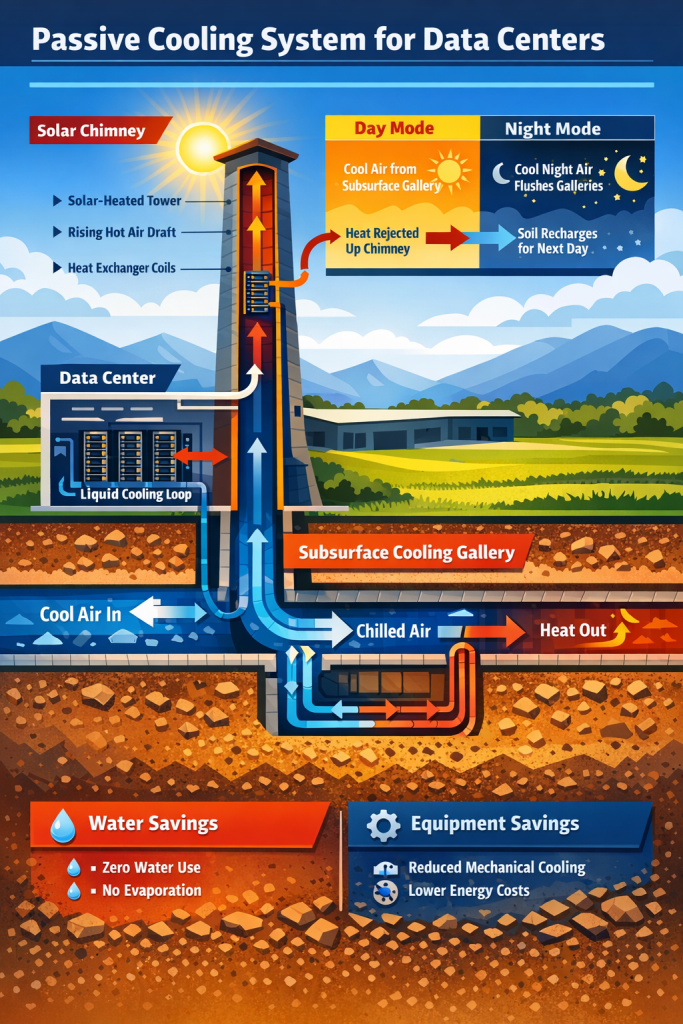
These consist of long, buried ducts or chambers constructed from concrete, masonry, or sealed piping materials. Typical depths of approximately 3–5 meters provide access to stable soil temperatures. As air passes through the galleries, heat is transferred to the surrounding soil, reducing inlet air temperature. At night, cooler ambient air can be flushed through the galleries to recharge the thermal mass.
3.2 Solar Chimney with Integrated Heat Exchangers
A solar chimney is a tall vertical shaft with an absorptive interior surface. Solar heating raises the temperature of air inside the chimney, creating buoyant upward flow. Heat exchangers or radiator coils placed within the chimney throat allow heat from a liquid cooling loop to be rejected into this airflow using natural draft rather than powered fans.
3.3 Closed-Loop Liquid Cooling
Heat from server racks is collected in a closed liquid loop using standard cooling distribution units. The coolant—water-glycol or dielectric fluid—is circulated through heat exchangers within the chimney. The loop is fully sealed and does not rely on evaporation, resulting in zero consumptive water use.
4. Physical Principles
4.1 Stack Effect
Buoyancy-driven airflow in a chimney is proportional to the height of the stack and the temperature difference between the air inside the chimney and the ambient air. For example, a chimney approximately 20 meters tall with a 10 K temperature rise can generate several cubic meters per second of airflow, depending on geometry and losses.
4.2 Soil Thermal Mass
At sufficient depth, soil temperature remains nearly constant over daily and seasonal cycles. Air passing through long underground galleries can typically be cooled by 5–10 K, depending on soil properties, moisture content, and gallery length.
4.3 Combined Cooling Potential
In a dry, mid-latitude climate, a representative configuration may yield approximately 40–45 kW of sensible cooling per chimney. Multiple chimneys can be arrayed to scale capacity approximately linearly.
5. Operational Modes
5.1 Day Mode
During hot conditions, air is drawn through subterranean galleries, pre-cooled by the soil, passed through chimney-mounted heat exchangers, and exhausted upward via solar-driven draft. Operation is primarily passive.
5.2 Night Mode
At night, cooler ambient air is flushed through the galleries to recharge soil thermal mass. The liquid loop may optionally be routed through radiative panels to reject heat to the night sky, improving next-day performance.
5.3 Peak Load Mode
During extreme conditions, small electrically efficient fans may supplement airflow across heat exchangers. Even in this mode, the system remains water-free and significantly reduces reliance on fully mechanical cooling.
6. Implementation Considerations
6.1 Climate Suitability
The approach is best suited to regions with dry or semi-arid climates, high solar availability, large diurnal temperature swings, and sufficient land area for underground galleries and chimneys.
6.2 Structural and Environmental Factors
Condensation management, drainage, filtration at air intakes, and access for inspection and maintenance are essential design considerations.
6.3 Integration with Existing Facilities
The system can be integrated as a hybrid retrofit alongside existing liquid-cooled infrastructure, reducing chiller load, cooling-tower usage, and overall water demand.
7. Environmental and Economic Benefits
7.1 Zero Consumptive Water Use
The system eliminates evaporative losses associated with cooling towers, directly reducing freshwater consumption.
7.2 Reduced Energy Use
Passive airflow replaces fans for much of the operating cycle, while pre-cooling lowers compressor runtime.
7.3 Reduced Capital and Maintenance Requirements
Lower peak cooling demand may allow for smaller chillers and fewer mechanical components, reducing both capital expenditure and long-term maintenance.
8. Public Domain Dedication (CC0)
This work, including all descriptions and conceptual frameworks, is released under the Creative Commons CC0 1.0 Universal Public Domain Dedication. Anyone may use, modify, implement, publish, or commercialize the concept without permission or restriction.
9. Author’s Philosophical Statement
This concept is offered freely to the world. The expansion of AI infrastructure demands solutions that protect the planet rather than burden it. If a simple idea—rooted in natural forces and long-standing architectural principles—can reduce environmental strain, withholding it would serve no one.
By releasing this work openly, the author affirms the belief that innovation should elevate communities broadly, not concentrate benefit narrowly. This system belongs to all who choose to use and improve it responsibly.
10. Stewardship & Voluntary Support (Optional)
This work is released openly for public use. Organizations or individuals who find the approach valuable and wish to discuss voluntary stewardship support—such as helping homeowners and small communities apply passive, water-saving cooling methods, or acknowledging the originator’s open contribution—may do so by contacting PassiveSolarCooling@gmail.com. Any such discussions are informal, voluntary, and intended solely to support responsible dissemination of passive cooling approaches.
11. Conclusion
The integration of solar chimneys, subterranean thermal galleries, and closed-loop liquid cooling presents a scalable, water-free approach to data-center heat rejection. Its passive operation, low complexity, and environmental benefits make it well-suited to regions where water scarcity intersects with increasing computational demand.
Released openly into the public domain and accompanied by a voluntary stewardship framework, this method is intended to support both technological progress and long-term planetary well-being.
Appendix A: Ellis Passive Cooling Stewardship License (EPCSL)
Ellis Passive Cooling Stewardship License (EPCSL)
Version 1.2 — Informative, Voluntary, Nonprofit-Optional Edition
Author: Jonathan Ellis
Released: January 2026
Preamble
The passive solar chimney + subterranean cooling method is freely given to the world under the CC0 Public Domain Dedication. No one is restricted in its use, and no permission is required. Yet the purpose of open innovation is not only freedom — it is benefit. This stewardship license offers an ethical, voluntary pathway for organizations to reintegrate a small portion of the benefits they receive, supporting global access to passive cooling and symbolically recognizing the originator’s open contribution.
1. Legal Status
1.1 The cooling system concept is fully dedicated to the public domain under the Creative Commons CC0 1.0 Universal Dedication.
1.2 No restrictions, conditions, or licensing obligations apply.
1.3 Participation in this stewardship framework is voluntary and does not alter any rights granted under CC0.
2. Purpose of the Stewardship Framework
The EPCSL aims to:
– Encourage voluntary reinvestment of water and energy savings into community benefit.
– Expand homeowner and community access to passive cooling technologies.
– Provide a symbolic recognition pathway for Jonathan Ellis and designated heirs.
3. Voluntary Contribution Structure
Organizations adopting the cooling method are invited to:
3.1 Estimate Value of Savings
This may include reduced water consumption, lower mechanical cooling costs, reduced electrical demand, or avoided capital expenditures.
3.2 Contribute a Self-Selected Percentage
A recommended voluntary contribution range is 0.1%–1.0% of annual savings.
3.3 Contribute to Two Stewardship Funds
A. Homeowner Access Fund
Supports homeowner and community adoption of passive cooling systems, including materials, education, and pilot installations.
B. Ellis Recognition Fund
Provides a modest symbolic honorarium to Jonathan Ellis and designated heirs.
Participation is voluntary, and contributions may be directed to either or both funds.
4. Administration of Funds
The EPCSL does not require a formal nonprofit entity. Contributions may be administered through:
– Designated transparent stewardship accounts maintained by the author or trusted stewards,
– Fiscal sponsorship through an existing nonprofit (optional), or
– A future nonprofit entity if desired.
Annual public summaries of contributions and distributions should be published to ensure transparency.
5. Stewardship Partner Status
Organizations contributing through this framework may publicly describe themselves as:
“Solar Passive Cooling Stewardship Partners”
They may use this designation in sustainability reporting, marketing materials, and public communications.
6. Recognition and Attribution (Optional)
Although attribution is not required under CC0, organizations may acknowledge inspiration from:
“Passive Solar Chimney + Subterranean Cooling Integration — Jonathan Ellis.”
7. No Restrictions on Use
The EPCSL creates no legal obligations and imposes no conditions on the use, modification, or commercialization of the cooling method.
8. Philosophical Foundation
This framework is based on the belief that open innovation can serve both technological progress and social good. Stewardship contributions are not required but represent an opportunity for organizations to demonstrate environmental responsibility, equity, and gratitude for open knowledge.
9. Contact
Jonathan Ellis
Contact: PassiveSolarCooling@gmail.com
END OF DOCUMENT
PDF version available upon request.